

Review: Transformative Mediation from Community Justice Initiative
This spring I completed my first intensive training in a while - Transformative Mediation offered by the Community Justice Initiative (CJI) in Kitchener, Ontario. My attendance was made possible in part through the support of Dr. Gladys Rowe (Swampy Cree) at the Indigenous Insights Collective, where our work is guided by collaboration, integrity, and love. I hope this review is helpful to those interested in upskilling their capacity to navigate conflict!
About
I became curious about restorative justice through numerous experiences - harm is done to and by various people in so many contexts. What role might I be able to play as a consultant in helping participants find comfort, healing, and opportunity to rebuild? Training seemed like a good avenue to enhance my understanding.
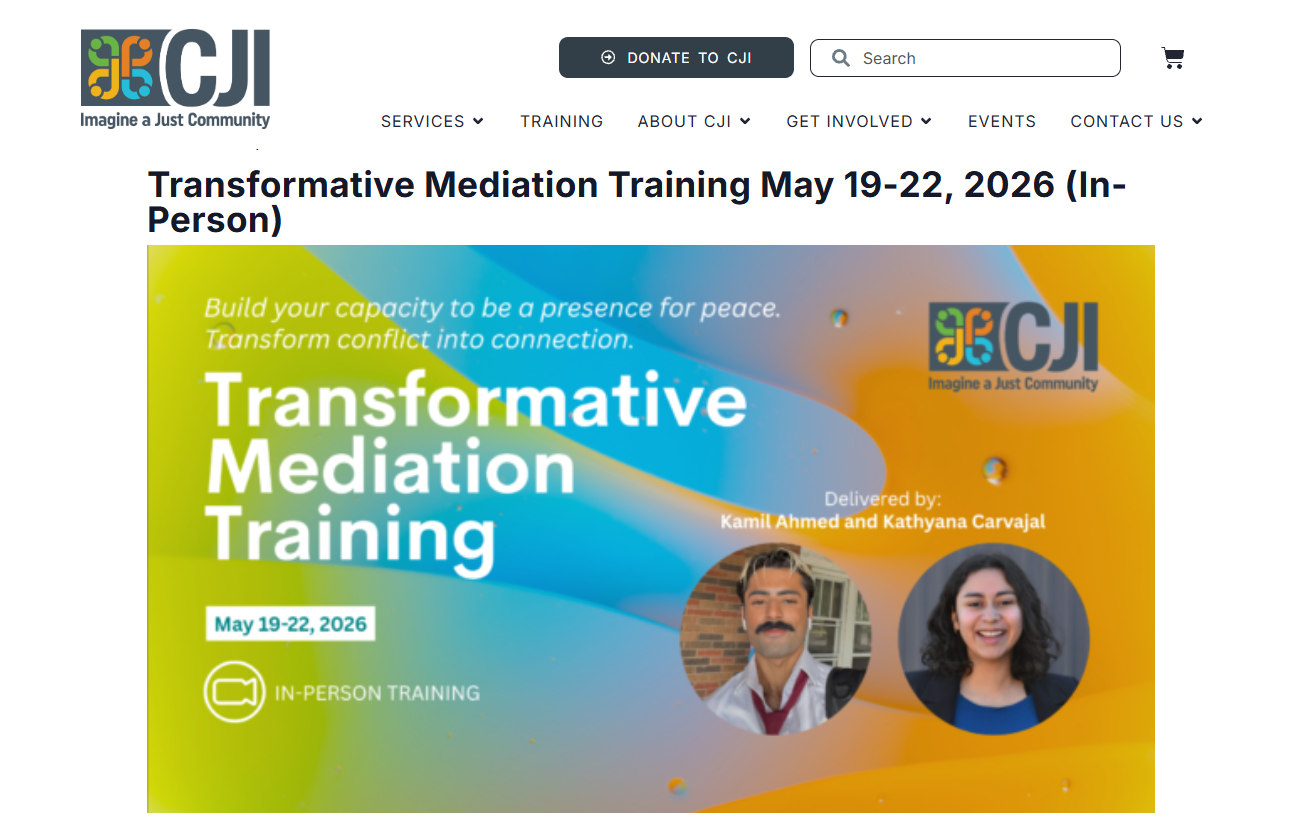
Screenshot of the Community Justice Intiative web page advertising the Transformative Mediation Training.
This Transformative Mediation training is advertised as follows:
Join us for an immersive Transformative Mediation Training designed to cultivate deep listening, empathy, and conflict resolution skills through the lens of restorative justice. Grounded in the principles of recognition, empowerment, and mutual understanding, this training equips participants with the tools to support individuals in navigating conflict with authenticity and care.
Unlike traditional approaches that focus on resolving issues or reaching agreements, transformative mediation emphasizes shifting the quality of conflict interaction—encouraging personal growth, relational repair, and increased capacity for dialogue. Participants will learn to stay present in difficult conversations, support self-determination, and foster constructive engagement, even in high-conflict situations.
Ideal for community leaders, educators, justice practitioners, and anyone committed to healing-centered practices, this training includes:
Fundamental frameworks of Restorative Justice
Core frameworks of transformative mediation
Skills-based practice in reflective listening and multi-partial facilitation
Role-plays based on real-life conflict scenarios
Exploration of power dynamics, trauma, and cultural context in mediation
Guidance on applying these principles in community, organizational, or justice settings
Led by experienced restorative practitioners, this training supports a shift from managing conflict to transforming relationships—honoring the humanity of all involved.
Build your capacity to be a presence for peace. Transform conflict into connection.
I chose this opportunity because it appeared to offer a depth of learning that didn’t seem to be attainable by other trainings that focused on lectures and readings.
As many of us know through experience, approaches grown by the participants themselves are much more likely to work than solutions imposed by someone else. But what do we do when people in conflict are unable to find a solution on their own? How can we be helpful and supportive rather than intrusive and directive?
This training offered insight and time to reflect in a way that enabled me to make major improvements to my understanding.
The Intensive
This intensive was four days long, in person, and located in Waterloo, Ontario. We had 11 participants and two facilitators, Kamil and Kathyana. This training is also offered online over the course of 8 half days on Zoom. If it is available to you, I definitely endorse the in-person option.
Day 1 was well-spent on the history and philosophy of the kind of Transformative Mediation practiced by CJI. A younger version of myself might have been anxious to get into the “real” training, but this time spent on worldview was incredibly important. Transformative Mediation is a technique that can take on different flavours depending on the context it serves. Later in the training, I noticed some resistance within my body to some key principles. I was able to locate that friction and understand my reaction because of the groundwork laid by Kathyana and Kamil on Day 1.
(If you are curious what the friction was, it was around having some sort of directionality as a facilitator. In my practice, I am honest about the values I want my partners to have, or become open to. In the CJI brand of Transformative Mediation, it is not the role of mediators to push values onto the participants. This critical difference probably arises from the fact that CJI works in a very different context than I do. And that is just fine!)
Day 2 focused more closely on the Transformative Mediation process. We spent time talking broadly about the steps and their purpose and we also paid attention to specific details that help us stay mindful of how our actions align with our intentions in a mediation space.
Days 3 and 4 centred embodied praxis (read: role play!) to give us an opportunity to put our skills into action and discuss with the group.
We sat in circle for most of the training, and there were plenty of opportunities to share and learn from others’ experiences. While Kamil and Kathyana clearly held facilitator roles and had a wealth of knowledge to share, the perspectives of the other participants were also extremely valuable in understanding different contexts and perspectives around conflict and mediation.
Try it yourself!
This is a fantastic training that has much to offer to anyone who works with, lives with, or otherwise deals with other human beings. Is that all of us?! I left with so many lessons that find relevance in my professional life, personal life, and often both. Additionally, I left with new questions that will roll around my mind for a while. Anyone who knows me knows how much I appreciate food for thought and the importance of tricky questions in deepening my reflective practice.
CJI maintains a calendar of upcoming trainings and sign up is easy to navigate. Kathyana and Kamil informed us that they have been working hard on a new training about identity-based harm that may be piloted later this year (2026). After such a fantastic experience at Transformative Mediation, I am eager to keep an eye out for their new offering… I invite you to do the same!
